
CDL Drivers: Charged with Leaving the Scene of an Accident in Nebraska? Here's What You Need to Know
For most drivers, a Leaving the Scene of an Accident charge is a serious traffic or criminal matter.
For a commercial driver's license (CDL) holder, it can be much more than that.
A conviction will trigger a mandatory one-year CDL disqualification under federal law, even if the court only imposes a fine. That means what appears to be "just another traffic ticket" can cost you your livelihood.
If you've been charged in Nebraska, understanding both Nebraska law and the Federal Motor Carrier Safety Administration (FMCSA) regulations is critical before deciding how to resolve your case.
Why Leaving the Scene Is Different for CDL Drivers
Many traffic violations carry points.
Leaving the Scene is different.
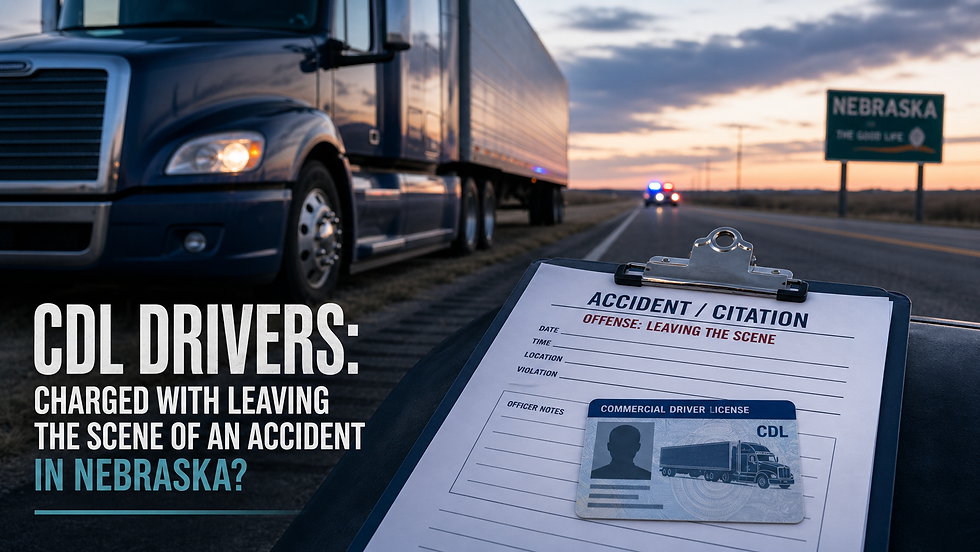
Under FMCSA regulations, Leaving the Scene of an Accident is classified as a major offense. A conviction will result in a mandatory one-year CDL disqualification for a first offense. If hazardous materials are involved, the disqualification may be even longer. A second major offense can result in lifetime disqualification.
That means the consequences often extend far beyond the courtroom.
Many drivers are surprised to learn that the biggest penalty isn't the fine or probation. It's the potential loss of the CDL they rely on to support themselves and their families.
"I Didn't Leave the Scene."
One of the biggest misconceptions about these cases is what "Leaving the Scene" actually means.
Many drivers picture someone intentionally fleeing after a serious crash.
In reality, these cases often involve much more complicated situations:
A driver doesn't realize contact occurred.
A minor sideswipe or backing incident goes unnoticed.
A driver believes there was no damage and continues driving.
Confusion exists about whether the driver fulfilled all legal duties after the accident.
The FMCSA interprets "Leaving the Scene" broadly. It generally includes situations where state law required a driver to stop, provide identifying information, render aid if necessary, or otherwise comply with accident reporting obligations.
Every case turns on its own facts.
Don't Assume Paying the Fine Solves the Problem
One of the biggest mistakes CDL drivers make is treating this like an ordinary traffic ticket.
Many drivers think:
"If I just pay it, I'll be done."
Unfortunately, that can be exactly what creates the CDL problem.
Once there is a conviction for a disqualifying offense, federal CDL consequences will follow regardless of the sentence imposed by the court. Judges and prosecutors are deciding the criminal case. The FMCSA rules create a separate set of consequences for commercial drivers.
Why Experience with CDL Cases Matters
Not every attorney regularly represents CDL drivers.
Commercial drivers operate under a different set of rules than the average motorist. Understanding the interaction between Nebraska law and federal CDL regulations is an important part of evaluating any proposed resolution.
That includes questions such as:
Does this charge trigger a mandatory CDL disqualification?
Is there a lawful alternative resolution?
Does the proposed plea accurately reflect the underlying conduct while avoiding unnecessary CDL consequences?
What are the long-term employment implications?
These are questions every CDL driver should ask before accepting any plea agreement.
Every Leaving the Scene Case Is Different
There is no one-size-fits-all defense.
Depending on the facts, issues may include:
Whether the driver knew an accident occurred.
Whether the prosecution can prove every required element.
Whether witnesses or physical evidence support the allegation.
Whether there are lawful opportunities to negotiate an alternative resolution.
No attorney can guarantee a particular outcome.
However, understanding the federal CDL consequences often changes how these cases should be approached.
What Should You Do After Being Charged?
If you're a CDL holder, consider taking these steps:
Do not automatically pay the citation.
Obtain a copy of every citation, complaint, and accident report.
Notify your attorney of any upcoming court dates.
Avoid making assumptions about the effect on your CDL.
Speak with an attorney who regularly handles CDL cases before making any decisions.
Waiting until after a conviction will significantly limit your options.
How Flatwater Legal Helps CDL Drivers Throughout Nebraska
At Flatwater Legal, our practice focuses exclusively on Nebraska traffic and CDL cases.
We regularly represent commercial drivers throughout Nebraska and understand that protecting your CDL is often more important than reducing a fine.
Leaving the Scene of an Accident cases require more than simply appearing in court. They require understanding how Nebraska law and federal CDL regulations work together, identifying the true risks to your commercial driving privileges, and pursuing the best available resolution based on the facts of your case.
If you've been charged with Leaving the Scene of an Accident in Nebraska and you hold a CDL, contact Flatwater Legal as soon as possible. The decisions made early in the case can have lasting consequences for your driving career.
Can a Leaving the Scene Charge Be Reduced Without Violating the FMCSA Anti-Masking Rules?
Sometimes.
This is one of the most misunderstood areas of CDL law.
Federal regulations prohibit courts and prosecutors from masking CDL violations. In simple terms, that means they cannot amend, dismiss, or defer a charge simply to help a CDL holder avoid the federal consequences of a conviction. The underlying conduct must still be accurately reflected in the final disposition.
That does not mean every Leaving the Scene case must end in a conviction for Leaving the Scene.
Prosecutors retain broad discretion to evaluate the evidence, determine whether every element of the offense can be proven beyond a reasonable doubt, and resolve cases in a manner that accurately reflects the conduct supported by the evidence. If the facts justify a different charge, a reduction or amendment may be entirely appropriate and fully consistent with the anti-masking regulations.
The key is that any resolution must be based on the facts of the case, not simply on a desire to avoid CDL consequences.
This is where experience with FMCSA regulations matters.
An attorney who regularly represents CDL drivers understands that the goal is not to ask for an improper favor or special treatment. The goal is to identify a lawful resolution that accurately reflects what actually happened while protecting the driver's commercial driving privileges whenever the facts and the law allow.
Every case is different. Some Leaving the Scene charges are supported by strong evidence and may leave little room for negotiation. Others present factual or legal issues that can lead to a different outcome. Evaluating those possibilities requires understanding both Nebraska law and the federal regulations governing CDL holders.
Need help now? Visit our Leaving the Scene of an Accident practice page to learn more or contact Flatwater Legal to discuss your case.


Comments